
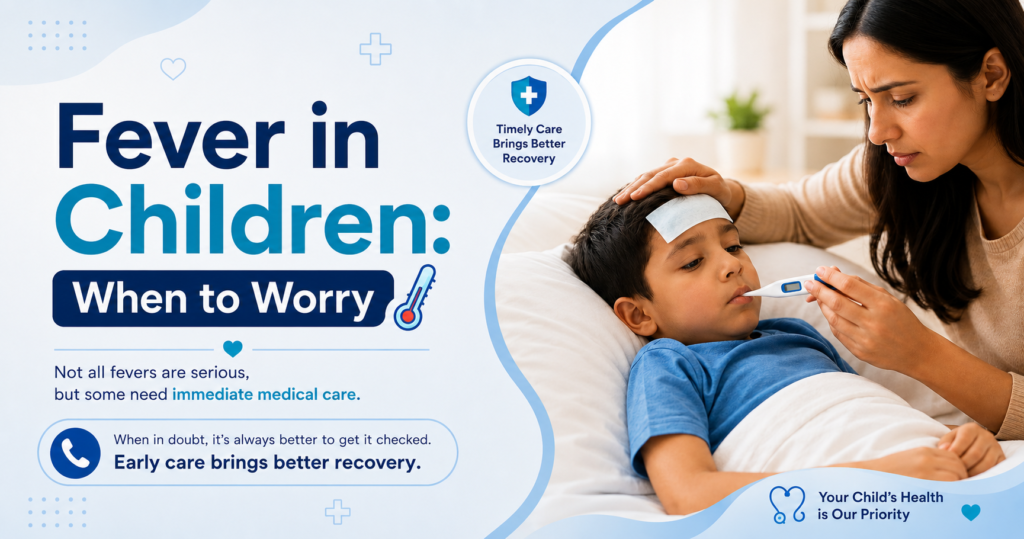
Fever in Children: When to Worry
Nothing rattles a parent quite like a hot forehead at night. When the thermometer beeps and displays a number in the hundreds, all of the worst-case scenarios instantly cross your mind. Here’s the thing though, fever on its own isn’t the villain everyone thinks it is. Simply put, the body is fortifying its defenses against any potentially invasive bacteria or viruses. The true question is not “is my child hot,” but rather “does this fever come with something that actually needs attention?”
Kids catch more, react stronger
Young immune systems haven’t built up a library of past infections to draw from yet. Thus, a bug that hardly registers with an adult might cause a toddler’s body temperature to spike. Colds, flu, throat infections, ear infections, even urinary tract infections in younger kids, these are the usual suspects. Teething is frequently blamed as well, although most pediatricians will tell you that it only causes a slight bump at most, not the kind of rise that requires medical attention.
Age changes the rules
Depending on your child’s age, a thermometer’s number can imply different things. For babies under three months, 100.4°F or above is not something to sit on, that calls for a same day doctor visit no matter how fine the baby otherwise seems. Older infants and toddlers have a bit more wiggle room, a fever up to 102°F that comes down with medicine and isn’t paired with other red flags can usually be managed from home. Cross 104°F though, at any age, and it’s time to get medical eyes on the situation.
Behavior tells you more than the reading does
Ask any experienced pediatrician and they’ll say the same thing in different words, watch how the kid is acting, not just what the display says. A child sipping water, making eye contact, and crying in their normal way when upset is generally not in immediate trouble even with a fairly high number. What should grab your attention instead is a child who’s oddly hard to wake, won’t take any fluids for hours, or has a cry that sounds off, weaker or more high pitched than usual.
Situations that skip the wait and watch phase
Some combinations mean pick up the phone right away. Fever under three months of age. A rash that doesn’t fade under the pressure of a glass. A stiff neck. Any seizure, however brief. Breathing that looks fast, effortful, or just wrong. Total refusal to drink anything. A fever that keeps rising past 104°F no matter what you try. None of these are “wait until morning” situations.
Handling it at home
For the milder, less alarming cases, a few basics go a long way. Since the actual guidelines are based on weight, dose fever medication based on weight rather than age. Right now, fluids are more important than food; taking tiny, regular sips is preferable to forcing a large glass at once. Skip the heavy blankets, that old idea about sweating a fever out tends to trap heat rather than release it. A lukewarm sponge down can help ease discomfort, but steer clear of ice cold water, it triggers shivering which can push the temperature up instead of down.
The bottom line
The majority of children’s fevers go away on their own in a few days and don’t indicate anything worrisome. Behavior is more important than precise numbers, and if something seems strange, don’t hesitate to call your pediatrician.
FAQs
Q1. What counts as a fever in a child?
Ans- Generally 100.4°F or higher.For infants younger than three months, this reading alone is sufficient justification for an immediate visit to the doctor.
Q2. What’s the right first step when a child gets a fever?
Ans- Watch their behavior, keep fluids going, dress them lightly, and use a weight based dose of fever medicine if it seems needed.
Q3. Does teething cause fever?
Ans- It can cause a slight rise in temperature, but anything above 100.4°F is more likely an infection than teething alone.
Q4. Which symptoms alongside fever need urgent care?
Ans- A stiff neck, seizures, labored breathing, a rash that won’t fade under pressure, or a child who’s unusually hard to wake.
Q5. Should I use ice cold water to bring down a fever?
Ans- No. It causes shivering, which can raise body temperature further. A lukewarm sponge bath works better and is safer.